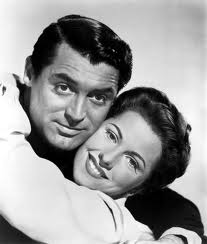
My love affair with biographies of film stars continues, with two biographies of two almost forgotten stars, Irene Dunne and Barbara Stanwyck.
I know Irene Dunne from her work with Cary Grant - she appeared in two screwball comedies with him (The Awful Truth and My Favourite Wife) as well as one melodrama, Penny Serenade. If you haven't seen these films you should - they're fantastic and have aged a lot better than many movies from the '30s and early '40s. Dunne and Grant have fantastic chemistry and they play perfectly off each other, resulting in really entertaining films that sparkle with humour and wit. During the studio era, Dunne was one of Hollywood's biggest female stars and was loved by both critics and fans, receiving five Academy Awards and numerous glowing reviews. Despite this contemporary fame, only her Cary Grant films are easily available and Dunne has largely been forgotten in Hollywood history.
Wes D. Gehring's book is a loving portrayal of the life and times of Irene Dunne, from her early days growing up in Kentucky through her career, marriage and retirement. He quotes extensively from his personal interviews with Dunne as well as referring to other historical sources. In these pages, Dunne appears as an admirable person, a hard-working and talented singer and actress and a loyal and faithful wife. The thing is, while it's great that she was all of those things, none of them are particularly interesting to read about! Any scandal, such as the rumours of Dunne's infidelity during the period her and her dentist husband Frank Griffin lived in different cities (her in Los Angeles and he in New York) or conflicts with studios over roles and typecasting, are quickly brushed past in favour of glowing accounts of Dunne's wonderful performances or virtuous charitable or admirable personal acts. This book is not a bad book but is only for hardcore Irene Dunne fans.
Barbara Stanyck is, without a doubt, one of my favourite Hollywood stars. I wrote my honours thesis on her and, even though I have watched her movies literally hundreds of time, I never tire of them. Like Dunne, Stanwyck was a huge star and was at one stage the highest paid female star in America. Also like Dunne, Stanwyck has largely faded from public consciousness, although her roles in classic films like Double Indemnity and Stella Dallas mean she's a favourite of critics and film students.
In Barbara Stanwyck: The Miracle Woman, Dan Callahan makes an impassioned case for Stanwyck's position as a great Hollywood star. Starting from her birth as Ruby Stevens in 1907, Callahan describes her poor and tragic upbringing (her mother was killed in a traffic accident and her father abandoned Ruby and her brother and sister shortly afterwards, meaning Stanwyck spent much of her childhood moving from foster home to foster home) before beginning an exhaustive cataloguing of Stanwyck's films.
This, for me, was the biggest flaw of this book. Neither a strict biography nor an academic star study, Callahan draws direct parallels between the actions of Stanwyck's characters and her personal life. His detailed discussions of Stanwyck's films were written as if he had an omnipotent notion of how Stanwyck felt when making the movies. I found this incredibly irritating, which is really disappointing since I was really interested in Callahan's discussions of movies that are currently unavailable for general viewing or are impossibly hard to get access to. After what felt like the 100th reference to Ruby Steven's tragic past I couldn't take it anymore and returned the book to the library. This was a very disappointing experience.
I wouldn't recommend either of these books but reading them sparked a massive old-movie binge viewing fest but, since my disappointing reading experience sparked an excellent viewing experience, I'm not complaining very loudly.
Showing posts with label movie-star-biography. Show all posts
Saturday, March 16, 2013
Wednesday, September 26, 2012
No Bed of Roses by Joan Fontaine
Joan de Bouviour de Havilland, aka Joan Fontaine, is an Academy Award-winning actress from Hollywood's Golden Era. Today she's most remembered for her role as "I" de Winter in Alfred Hitchcock's Gothic masterpiece Rebecca (1940), opposite a very dashing Laurence Olivier, and for her ongoing feud with her sister, the also Oscar-winning Olivia de Havilland, who is best remembered for her performance as Melanie in Gone With the Wind. Joan Fontaine has always been one of my favourite Classic Hollywood stars - she's a delightful actress to watch.
As the title suggests, Joan Fontaine's story was never going to be a happy one. Part misery memoir, the early part of the book details her abusive and restrictive childhood. Born in Japan, her father abandoned her mother for the family's Japanese maid, forcing Joan, Olivia and their mother to start a new life in America. Her mother remarried a stern, controlling man, (Danny Fontaine) and Joan and Olivia's childhood was strict, rigid and unhappy. Both of the girls had left the household by the time they were 16. The book then tells Joan story as she moves back to Japan to live with her father for a year and then, after he propositions her (ewww!) her return to America, describing her many films, loves, husbands and events from then until the publication of the book in 1978.
This book is a wonderful read. Reading it felt like a Saturday afternoon on the couch watching a black-and-white movie with fabulous dresses, sparkling dialogue ahold d Hollywood glamour. Fontaine has a lovely confessional yet entertaining tone and her writing has great wit and perception. No Bed of Roses gives a clear picture of what it's like to be a very beautiful woman, with constant marriage proposals and propositions (from Howard Hughes and JFK's dad, to name a few!), men asking for your room key so they could come into your hotel room to clean your shoes while you were out (!!!) and being taken on extravagant holidays and dinners and shopping trips. The book is also interesting in that it it details how little control actors had in the studio system, where they were contracted to studios for seven-year periods and had really limited ability to choose what movies they starred in, how much they were paid, how often they worked or even which studio they worked at. (Incidentally, Joan's sister Olivia took Warner Brothers to court to end this restrictive practice and was instrumental in changing the labour laws, with a law named after her - the de Havilland law - which still has influence today.)
From a feminist perspective, this because is fascinating because it deals with a successful and intelligent woman's process of negotiation for independence in a world where the options available to women, both culturally and legally, were very limited. Fontaine earned more than her husbands (she had four) for most of her life. She was also a single parent and had to deal with the requirement to travel for her work but be a mother at the same time. She was also a determined woman who wasn't afraid or ashamed of her sexuality, determination and drive.
Despite its many pleasures, No Bed of Roses does have a few WTF moments - her decision to take a child home with her from a trip to Peru like a human souvenir and the effective abandonment of her two children when they reached their teens are bizarre in both their recounting and justification. There are far fewer mentions of her sister than I expected although we are left in absolutely no doubt that Joan believes all fault for their estrangement comes from Olivia. But despite those flaws, this in an engaging story of a headstrong, independent, beautiful woman with a ridiculously weak immune system. The saddest thing about the story is that Joan Fontaine really believes that no-one every really loved her enough, not even her own family.
Subscribe to:
Posts (Atom)