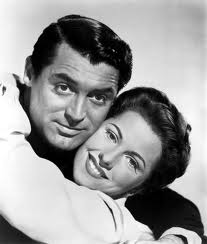
Showing posts with label film-star-biography. Show all posts

Friday, May 3, 2013

Sophia, Living and Loving by A Hotchner


Continuing my trend of reading female star (auto)biographies, I read Sophia Loren’s autobiography, Sophia, Living and Loving. I recently watched Houseboat, which stars Loren and Cary Grant, and I was reminded how really gorgeous both of those actors were. I knew that they had had a torrid love affair while filming The Pride and the Passion (it’s a terrible movie – don’t watch it) and I am a bit ashamed to admit that my desire to read this book was motivated by a salacious curiosity! Which I’m sure is something the publishers were counting on when they published this book.

The story opens like a standard ‘70s film star biography with an anecdote that determines which parent the film star blames for the childhood trauma that shapes the rest of her life. It is her father, who impregnated her mother but refused to marry her, condemning her to a life of scandal and shame. Sophia (born Sofia Scicolone) grew up in a small poor Italian town called Pozzuoli, near Naples. As there was a munitions factory in Pozzuoli, the town got bombed by the Allieds during the war so Sophie and her family were forced to evacuate to Naples, where they lived in near starvation until the end of the war. I know this exposes my ignorance but I knew very little about the Italian experience of World War II and I found Loren’s story about Four Days of Naples touching and sad.

After the war, they moved back to Pozzuoli, where Loren grew up, filled in and started entering beauty contests. After wining wallpaper and a trip to Rome in one contest (can you imagine if America’s Next Top Model contestants were given wallpaper as a prize? Too funny) she moved to Rome and started working as a model and an actress. The rest, as they say, is history and Sophia went on to have a busy life as an actress, becoming the first woman to win an Academy Award for a non-English role (in 1961 for Two Women) and as a concubine, as officially designated by the Catholic Church for firstly being in a relation with a married man (Carlo Ponti) and then marrying him and bearing his children.
I am a bit confused at the writing of Sophia – it has an author listed (A. Hotchner) but is written in the first person. It also features short first-person anecdotes about Sophia from the people close to her, like her husband and her sister. I’m not sure if it is A Hotchner’s imaginings of what Sophia would say or if s/he has written up what Sophia told her/him? And the same with the anecdotes?  I think in one her husband admits to cheating on her, which I did find amazing because she looked like this:


But who really knows what goes on in another person’s relationship?

Despite this confusion, I did enjoy this book. Loren has done some amazing things, like working with Marlon Brando in a Charlie Chaplin-directed film – is that not the bizarrest combination ever? She was the centre of a number of scandals internationally, most famously with the Carlo Ponti-bigamy thing but also for wearing a crown when meeting Queen Elizabeth. She has a nice Italian-mamma-esque writing style (or Hotchner does, I’m not sure) and reading about her interesting life was a pleasant way to spend the afternoon.

I give it three stars (downgraded from four because of the unclear authorage).

Wednesday, September 26, 2012

No Bed of Roses by Joan Fontaine


Joan de Bouviour de Havilland, aka Joan Fontaine, is an Academy Award-winning actress from Hollywood's Golden Era. Today she's most remembered for her role as "I" de Winter in Alfred Hitchcock's Gothic masterpiece Rebecca (1940), opposite a very dashing Laurence Olivier, and for her ongoing feud with her sister, the also Oscar-winning Olivia de Havilland, who is best remembered for her performance as Melanie in Gone With the Wind. Joan Fontaine has always been one of my favourite Classic Hollywood stars - she's a delightful actress to watch.

As the title suggests, Joan Fontaine's story was never going to be a happy one. Part misery memoir, the early part of the book details her abusive and restrictive childhood. Born in Japan, her father abandoned her mother for the family's Japanese maid, forcing Joan, Olivia and their mother to start a new life in America. Her mother remarried a stern, controlling man, (Danny Fontaine) and Joan and Olivia's childhood was strict, rigid and unhappy. Both of the girls had left the household by the time they were 16. The book then tells Joan story as she moves back to Japan to live with her father for a year and then, after he propositions her (ewww!) her return to America, describing her many films, loves, husbands and events from then until the publication of the book in 1978.  


This book is a wonderful read. Reading it felt like a Saturday afternoon on the couch watching a black-and-white movie with fabulous dresses, sparkling dialogue ahold d Hollywood glamour.  Fontaine has a lovely confessional yet entertaining tone and her writing has great wit and perception. No Bed of Roses gives a clear picture of what it's like to be a very beautiful woman, with constant marriage proposals and propositions (from Howard Hughes and JFK's dad, to name a few!), men asking for your room key so they could come into your hotel room to clean your shoes while you were out (!!!) and being taken on extravagant holidays and dinners and shopping trips. The book is also interesting in that it it details how little control actors had in the studio system, where they were contracted to studios for seven-year periods and had really limited ability to choose what movies they starred in, how much they were paid, how often they worked or even which studio they worked at. (Incidentally, Joan's sister Olivia took Warner Brothers to court to end this restrictive practice and was instrumental in changing the labour laws, with a law named after her - the de Havilland law - which still has influence today.)


From a feminist perspective, this because is fascinating because it deals with a successful and intelligent woman's process of negotiation for independence in a world where the options available to women, both culturally and legally, were very limited. Fontaine earned more than her husbands (she had four) for most of her life. She was also a single parent and had to deal with the requirement to travel for her work but be a mother at the same time. She was also a determined woman who wasn't afraid or ashamed of her sexuality, determination and drive.

Despite its many pleasures, No Bed of Roses does have a few WTF moments - her decision to take a child home with her from a trip to Peru like a human souvenir and the effective abandonment of her two children when they reached their teens are bizarre in both their recounting and justification. There are far fewer mentions of her sister than I expected although we are left in absolutely no doubt that Joan believes all fault for their estrangement comes from Olivia. But despite those flaws, this in an engaging story of a headstrong, independent, beautiful woman with a ridiculously weak immune system. The saddest thing about the story is that Joan Fontaine really believes that no-one every really loved her enough, not even her own family.